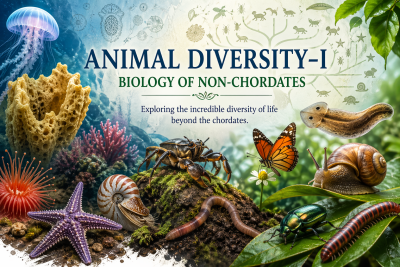
Animal Diversity – Non-chordates is a foundational course that explores the vast variety of animals lacking a notochord, highlighting their structural organization, classification, and evolutionary significance. It covers major phyla such as Porifera, Cnidaria, Platyhelminthes, Nematoda, Annelida, Arthropoda, Mollusca, Echinodermata, and Hemichordata, emphasizing their distinguishing characteristics, adaptations, and ecological roles. The course helps students understand body symmetry, coelom formation, segmentation, and organ system complexity across different groups. It also integrates concepts of life cycles, reproduction, and economic importance, enabling learners to appreciate the diversity and evolutionary relationships of non-chordate animals. Overall, it builds a strong base for advanced studies in zoology, ecology, and environmental science.
What will i learn?
- Understand the classification and general characteristics of major non-chordate phyla. Explain structural organization and functional adaptations in different non-chordate groups. Compare body plans, symmetry, segmentation, and levels of organization across phyla. Analyze the ecological roles and economic importance of non-chordate animals. Apply knowledge of non-chordate diversity to basic studies in zoology, ecology, and environmental science.
-
Whittaker's Five Kingdom Concept
Preview 00:19:46
-
Protozoa General Characters & Classification
Preview 00:30:30
-
Locomotion in Protozoa
Preview 00:27:59
-
Nutrition in Protozoa
Preview 00:26:36
-
Reproduction in Protozoa
Preview 00:32:45
-
Unit-I Text Material
Preview .
-
UNIT I QUIZ
0:00:00
-
Porifera General characters & Classification
Preview 00:18:52
-
Canal System in Sponges
Preview 00:11:21
-
Polymorphism in coelenterates
Preview 00:23:08
-
Corals and Coral Reefs
Preview 00:33:13
-
TEXT MATERIAL-General Characters and Classification of Porifera
Preview .
-
TEXT MATERIAL-Canal System in Sponges
Preview .
-
UNIT II TEXT MATERIAL Polymorphism in Coelenterates and Corals and Coral Reefs
Preview .
-
UNIT II QUIZ
0:00:00
-
General characters & classification of Platyhelminthes
Preview 00:15:20
-
Parasitic Adaptations of Flat worms
Preview 00:10:53
-
General Characters & classification of Nematyhelminthes
Preview 00:10:19
-
Life Cycle of Ascaris Lumbricoides
Preview 00:13:36
-
TEXT MATERIAL-UNIT 3
Preview .
-
UNIT III QUIZ
0:00:00
-
Annelida General Characters & Classification
Preview 00:23:10
-
Vermiculture
Preview 00:22:38
-
Arthropoda General Characters & Classification
Preview 00:32:05
-
Peripatus; Structure & Significance
Preview 00:18:36
-
Unit-IV Text Material
Preview .
-
UNIT IV QUIZ
0:00:00
-
Phylum Mollusca
Preview 00:07:19
-
Pearl Oyster farming
00:17:24
-
Phylum Echinodermata
Preview 00:14:25
-
Phylum Hemichordata
Preview 00:14:26
-
UNIT V TEXT MATERIAL
Preview .
-
UNIT V QUIZ
0:00:00
Reviews
-
 Chandana priya Bakuru
Write a public review